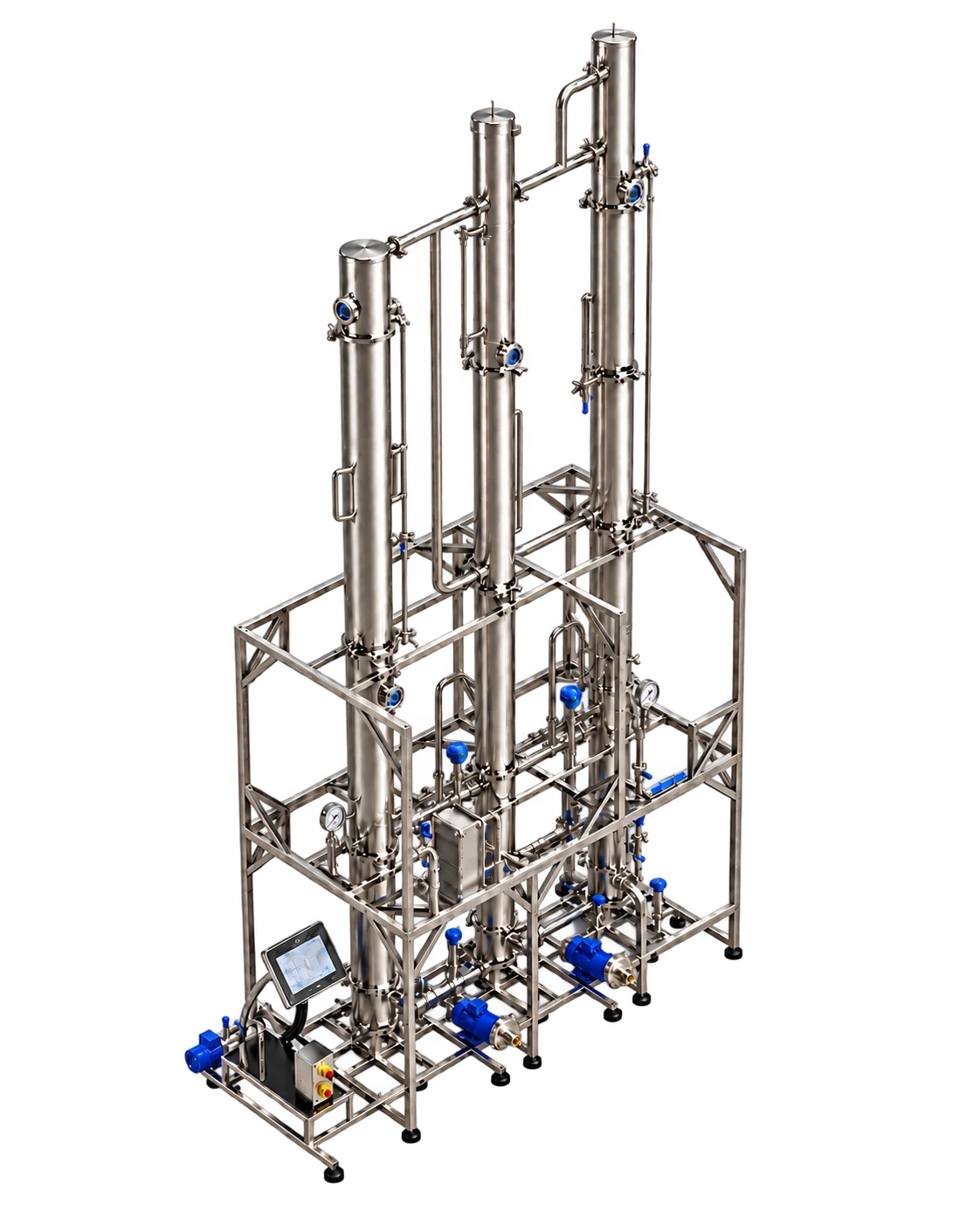
The illustrations show the design principle. We agree on the final layout of each model separately.
Process flow
Mash
Continuous three-column plant
Ethanol
Continuous operation with a three-column system. The components and specifications of individual assemblies are determined by the model and configuration.
Design
Three columns
Automation and operator tasks
The mash column, heads separation and rectification column operate in a shared continuous process. The control system maintains the specified process parameters and displays equipment status.
Operator
Readiness and mash supply
The operator prepares the mash according to the process instructions, checks connections and vessels, starts the equipment under the operating procedure, and monitors feedstock supply and product discharge. Deviations are investigated using system readings and the manufacturer's guidance.
Automation
Monitor the entire line
Operating parameters, events and statistics help assess the stability of the continuous process. Available adjustments, protective responses and data are defined for the specific configuration.
New interface: RU / EN / DE / FR / AR. The version and control interface languages are confirmed for the selected configuration.
Cloud-based operating statistics
Cloud-based statistics provide access to operating parameters and history. The customer receives data for monitoring production, while the technical team uses it to analyse operation and provide remote assistance.
Equipment
Parameters and events
Cloud-based statistics
Analysis and support
We define the statistics provided, data access and network connection when selecting the control system. Monitoring parameters does not replace the on-site operator.
Protection at three levels
Mechanical components, electrical protection and control algorithms work together. The specific devices and responses to deviations are defined by the project and described in the documentation.
Mechanical protection
Pressure and temperature monitoring, specified safety valves and connection checks help monitor the condition of process equipment.
Electrical protection
Earthing, protective devices and selected electrical components form part of the connection scheme. Site power supply and protection requirements are provided with the documentation.
Protective algorithms
The system logs specified errors, notifies the operator and performs the programmed response: limiting operation or stopping the relevant units. Responses depend on the sensors and algorithms of the selected version.
Select a protection scenario
Deviation
Message and log
Action under the procedure
Temperature or cooling deviation
If monitored parameters deviate, the operator receives a system message. The cause is checked using readings, the event log and operating procedures; the equipment response follows the specified protective scenario.
Automation helps detect and respond to the specified deviations. Correct connections, maintenance and the actions of a trained operator remain essential operating requirements.
Site layout
Layout for your site
We agree on module positions, connections and working aisles to suit your premises. The plan includes the main plant and auxiliary production areas.
≥ 5,5 mRoom ceiling height
Frame with main assemblies
Column support structure
Dismantlable for transport and maintenance. The scope of on-site work depends on the configuration.
Connections by configuration
We define the connection points for electricity or steam, water and drainage. We account for the selected heating and cooling options.
Access to controls and maintenance
We plan aisles and access to control panels, pumps and connections so the operator can monitor the plant and service its components comfortably.
Space for auxiliary areas
We allow space for fermentation, finished product and auxiliary equipment. The areas are selected according to the feedstock, and we agree on their layout at the site.
We agree on a plan for your premises
Send us the floor plan or room dimensions, ceiling height and utility locations. We use these to agree on the arrangement of modules, auxiliary areas and maintenance access.
We confirm power demand and steam and fuel consumption for the selected version of the 1000 L/day ethanol plant.
Electric version
For the selected configuration
We specify the electrical power demand based on the configuration, heating method and auxiliary equipment included.
Heat supply
For the selected configuration
We calculate steam and fuel consumption based on the selected energy source and the plant's operating mode.
Electricity
Suitable steam generator
Steam
Ethanol production
Energy efficiency: energy use per litre and useful heat recovery. We compare options using your site's operating mode and utilisation.
Self-contained cooling and heat recovery
Ethanol production
↻
Workshop heating + preheating mash water
Lower costs for water, wastewater disposal and additional heating
The cooling package is agreed separately. We account for its electricity consumption and the site's actual demand for heat.
Return condensate to the steam generator
In the version with indirect steam heating, steam transfers heat through a heat exchanger. The resulting condensate returns to the steam generator through a separate circuit.
Steam generator
Heat exchanger
Condensate
↶Return to the steam generator
Returning already heated water reduces the need for water treatment and reheating. We calculate the actual benefit for the heat supply scheme and operating conditions.
The steam and condensate circuit and the cooling circuit perform different tasks. Indirect heating, the return scheme and water requirements depend on the selected version.
Quality and support
Lux and Alpha spirit grades
from a compact plant
Producing the selected grade requires suitable feedstock, proper mash preparation and adherence to production conditions. Lux uses grain feedstock; Alpha uses wheat, rye or a mixture of both.
Suitable feedstock
Properly prepared mash
Process conditions
Product specifications
We select feedstock and technology for the intended ethanol use
For each feedstock, we define preparation, the processing cycle and target ethanol specifications. Suitability and expected yield are confirmed in the process sheet.
We select the process for food-grade or industrial ethanol applications. Lux and Alpha grades require suitable grain feedstock and compliance with process requirements.
GOST “Lux”
GOST “Alpha”
Wheat, rye or a mixture of both
Grades under GOST 5962-2013 can be obtained with suitable feedstock and compliance with the full set of process requirements.
Equipment checks before shipment
We assemble the plant at our site and connect the control system. In the buyer’s presence, we check the controls, sensors and pumps, verify that the equipment is complete, and inspect assembly quality. We demonstrate how to assemble, start and maintain the equipment.
With the buyer present
Plant assembly
Assembled plant with the control system connected
Component checks
Controls · sensors · pumps
Practical guidance
Assembly · start-up · maintenance
Packing and shipment
Dismantling with the buyer present
See the assembled plant
We assemble the equipment at our site and connect the control system. We show you the integrity of the structure and the quality of the components and assembly, and check the configuration against the scope of supply.
Checking controls, sensors and pumps
We check the controls, sensors and pumps in the buyer’s presence. We show the main components and connections and explain their functions.
How to assemble, start and maintain the plant
We walk you through the dismantling and assembly sequence and the procedures for starting and maintaining the plant. We show the connections and components the operator will work with.
Dismantling, packing and shipment
In the buyer’s presence, we dismantle the plant for transport, pack it and ship the equipment. We show how the dismantled sections are connected during subsequent assembly at the customer’s site.
The customer sees the assembled equipment and its preparation for transport, and receives practical guidance on assembly, start-up and maintenance.
What we agree before manufacture
Supply and support
Clear supply boundaries
Included with the equipment
The selected model's process units, control system, operating documentation and agreed support programme.
By selected configuration
Steam generator, water treatment, autonomous cooling, vessels, mixers and feedstock preparation equipment, according to the project specification.
Site preparation
Premises, connections, installation and qualified personnel for start-up. Before shipment, we provide requirements and assign responsibilities.
Final supply boundaries, additional systems and each party's work are defined in the specification and contract.
Contents and limits of supply
Dimensions and layout
Connections and resource consumption
Documentation and training program
Commissioning, support and a possible visit
Operating documentation
Documentation for assembly, connection, operation and maintenance of the selected model.
Process sheets
Mash preparation and processing conditions for the selected feedstock, tailored to food or technical applications of ethanol.
Production line training
Training in mash preparation, operator tasks and production line operation under the agreed programme. We help prepare for remotely guided commissioning.
Remote consultations
Help with commissioning, operation, settings and diagnostics. We review operating parameters and history, including cloud-based statistics.
Commissioning and support with the manufacturer's team
The standard arrangement is remotely guided commissioning and support under the agreed programme. The customer organises on-site work and provides qualified personnel and an operator.
Remote commissioning and operating support
We provide documentation and process instructions, train staff to operate the line, and help with settings and diagnostics. Process parameters and history, including cloud-based statistics, help investigate issues together with the customer.
A specialist visit when needed
If a task requires a specialist on site and the team is available to travel, a visit can be arranged separately. The scope of work, fee and timing are agreed separately.
Your next step
Get a proposal
for your production
Specify the intended ethanol use, required volume and contact details. We will add your selected model, feedstock and steam source to the request. We will prepare a proposal with the configuration, site requirements and supply price.
What is included in the supply, and what is handled on site?+
The equipment, documentation and support provided are defined in the specification and proposal. The customer organises installation work and site preparation. Commissioning is primarily guided remotely; a possible specialist visit is agreed separately according to need, team availability, fee and timing.
Can the plant operate without a continuous cooling water supply?+
Yes, with a separately agreed self-contained cooling package. A continuous supply and discharge of cooling water are not required; useful heat reuse depends on the system design and site conditions.
How do natural gas and LPG differ?+
Appropriate supply systems and steam generators are selected for mains gas and for LPG, a propane-butane mixture from a storage tank. Consumption figures for different fuels are calculated separately.
Can a specialist visit the site?+
Commissioning and support are primarily provided remotely. If needed and if the team is available, a specialist visit is arranged separately, with a separate fee, schedule and scope of work.